Roof emergency?
Call 01388 335 061 — same-day response, County Durham & the Northeast
01388 335 061·Inkerman, Tow Law · DL13 4HG·Mon–Fri 08:00–17:00
CHAS Advanced · NFRC · Reset ComplianceBrief
Leeds Grand Theatre approached Evenii to refurbish a section of natural slate roof that had reached the end of its serviceable life. The existing covering was sound in material terms but the fixings had failed — nail fatigue had loosened slates across the slope and the risk of further movement, slip and water ingress was no longer acceptable on a Grade II listed, operational theatre.
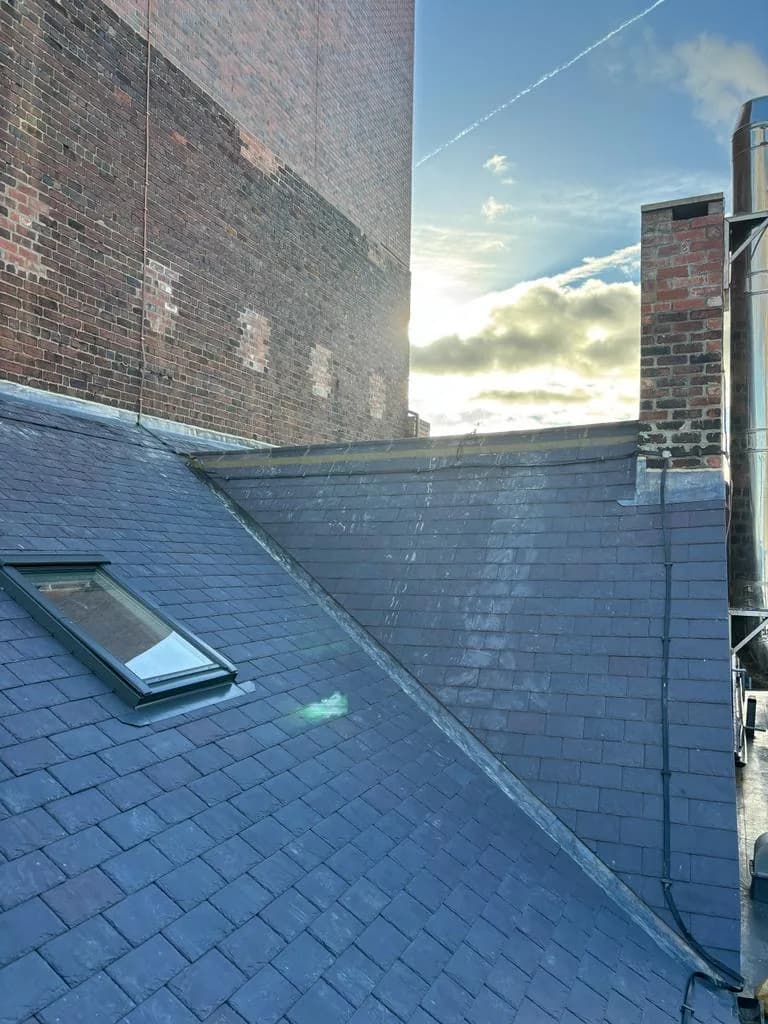
The instruction was to strip the existing slate, prepare the structure, replace timber where needed, and recover the roof in new Welsh slate with the full set of traditional heritage details — lead valleys, lead abutment flashings, rolltop ridges and hips, and new rooflights to the original openings. The works were specified to match the existing roof in material and detail.
Evenii travelled from Tow Law, County Durham to deliver the commission. The project was scoped, programmed and priced as a specialist heritage refurbishment rather than as routine roofing work.
02Roof condition and decision to strip
Nail fatigue is a known end-of-life condition on Welsh slate roofs of this age. The slate itself remains durable for well over a century, but the iron or copper nails that fix it can corrode and weaken long before the slate fails. Once a meaningful percentage of fixings has lost holding strength, slates begin to slip in wind events and patch repair becomes a holding exercise rather than a fix.
On survey, Evenii confirmed widespread fixing failure across the affected slope. Selective replacement would not have returned the roof to a known specification or given the theatre a defensible asset life, so the decision was taken — with the client — to strip the covering completely, inspect the structure beneath, and recover in new material with a fresh, fully specified detail set.
Stripping also gave access to the underlying timbers, the abutments and the valleys for proper inspection. Repairs and replacement of decayed sections could then be carried out before the new covering went down, rather than discovered later through a fault.
03Specification and materials
The roof was recovered in new Welsh slate to match the original. Welsh slate is the standard heritage specification on a building of this status — it is durable, holds its colour and weathers in a way that suits the conservation context. The slate was set on new breathable felt and new treated battens, fixed in accordance with the relevant British Standard for pitched slate roofing.
Leadwork was renewed throughout the working area. New code-appropriate lead was installed to the valleys and to the abutment flashings against parapets and adjoining structures. Ridges and hips were finished with traditional rolltop detailing in lead, dressed by hand on the roof. New rooflights were installed into the existing openings, with leadwork dressed around the upstands to maintain the watertight line.
Where the strip exposed decayed or weakened timber — rafters, sprockets and fixing battens at abutments — sections were cut out and replaced on instruction before recovering. All works were carried out in materials and details consistent with the listed status of the building.
04Site management around a live theatre
Leeds Grand Theatre is an operational venue with a published performance schedule. The roofing programme had to run without disrupting that schedule — no noise during performances, no debris in public areas, no access conflicts with audiences, staff or front-of-house operations.
Evenii coordinated access, lifting and material movement around the venue calendar. Stripped slate and waste were removed in controlled lifts at agreed times. Temporary protection was kept tight to the working area at the end of every shift so the building remained weathertight overnight and through any unplanned weather. Site welfare, deliveries and operative movement were routed away from public areas of the theatre.
Coordination with the venue team was constant rather than scheduled. The programme was built to absorb the realities of a live building — get-ins, get-outs, technical rehearsals and matinées — without holding up the roof.
05Outcome
The affected roof was returned to a known, fully specified condition: new Welsh slate, new felt and battens, new leadwork to valleys and abutments, new rolltop ridges and hips, new rooflights and timber repairs as instructed. The detail set is consistent with the listed status of the building and the asset life of the covering has been reset for a normal Welsh slate cycle.
The works were delivered without interruption to the theatre programme. The client received a refurbished roof slope, a defensible material specification and a signed-off handover — the basis for planned, rather than reactive, future maintenance.