Roof emergency?
Call 01388 335 061 — same-day response, County Durham & the Northeast
01388 335 061·Inkerman, Tow Law · DL13 4HG·Mon–Fri 08:00–17:00
CHAS Advanced · NFRC · Reset ComplianceThe brief: refurbish the roof to the Chapel and Masters Rooms without disturbing the wider estate.
Trinity House occupies a cluster of buildings on the Newcastle Quayside with roots stretching back roughly six hundred years. The estate is in continuous use, parts are open to the public, and the buildings sit inside a tightly drawn listed-building envelope on a constrained city-centre site.
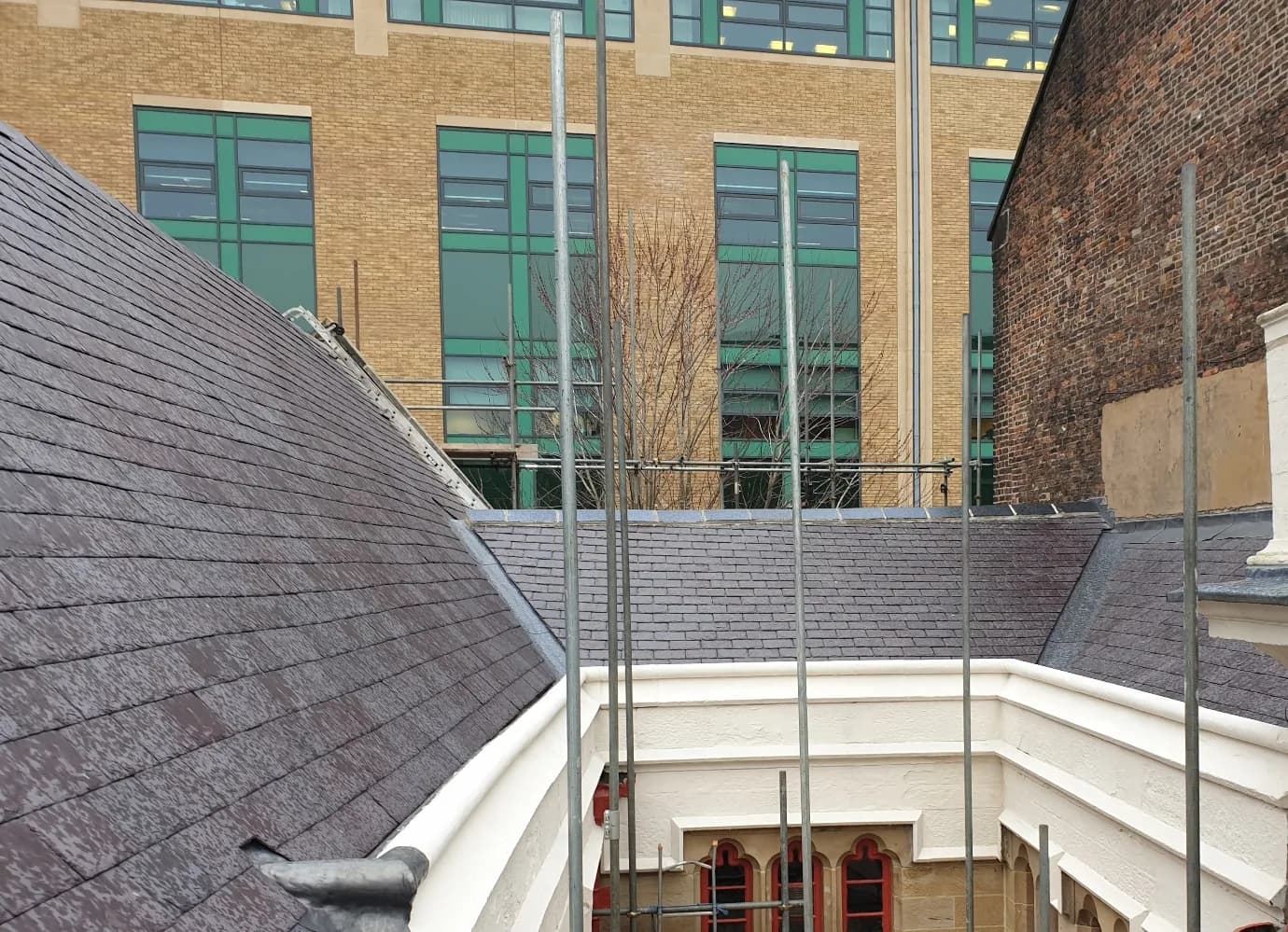
Evenii was instructed to recover the slate roofs over the Chapel and Masters Rooms, replace the lead box gutters and valleys, and complete associated stone restoration, lighting upgrades, WC refurbishment and hardwood louvre doors. The brief was a single programme delivered under one site presence rather than a series of disconnected trade visits.
The starting condition was typical of long-lived Quayside stock — failing slates and fixings, tired leadwork at the gutter and valley details, and stonework that needed careful repair before the new roof coverings could be re-laid.
02 — Heritage and listed-building constraintsHeritage controls shaped the specification and the way we worked on site.
Listed-building status set the rules. Materials, detailing and access arrangements all had to respect the historic fabric, the character of the Quayside conservation context, and the consents in place for the works. Substitutions and value-engineering shortcuts were not on the table.
The roofing specification matched the historic profile: Welsh slate to the main slopes, traditional lead box gutters and lead valleys at the junctions, and stone repair where existing copings, kneelers and surrounds had weathered or fractured. Detailing followed established heritage practice rather than modern flat-roof analogues.
Programme planning was built around the building staying in use. Public access, neighbouring occupiers and the wider estate operation continued through the works, so noise, dust, deliveries and lift movements were sequenced to protect day-to-day use of the site.
03 — Specification and materialsWelsh slate, traditional leadwork and stone repair to a listed roof.
The slate covering was specified in Welsh slate to match the existing roof character, fixed onto new battens and underlay following strip-back and substrate inspection. Verges, ridges and abutments were detailed in line with the historic profile rather than a generic recovering pack.
Leadwork covered new lead box gutters and lead valleys, sized and dressed to the existing details and laid to falls appropriate for the run lengths and the rainwater loads carried off the Chapel and Masters Rooms roofs. Code, bay length, fixings and welt detailing followed Lead Sheet Association guidance.
Stone restoration was completed alongside the roofing — copings, kneelers and abutments repaired or replaced where the slate and leadwork interfaces required a sound substrate. Lighting upgrades, WC refurbishment and hardwood louvre doors were programmed into the same site presence so the estate received the full package under one mobilisation.
04 — Site deliveryTented scaffolding, a single site presence and a live Quayside environment.
A tented scaffold was erected over the Chapel and Masters Rooms to protect the historic fabric and the interiors during strip-back, recovering and leadwork. The temporary roof gave us a controlled, weatherproof working envelope and removed the day-by-day weather risk that is always present on Tyneside.
Access on the Quayside is constrained — narrow approaches, public footways, neighbouring occupiers and tide-side conditions all influence how materials, scaffold and waste move on and off site. Deliveries, lifts and waste removal were scheduled to keep the public realm clear and the estate operational.
The site team worked to standard Evenii controls — CHAS Advanced safety management, NFRC workmanship standards and Reset Compliance for site conduct. RAMS, daily briefings and progress reporting kept the client estate team, the heritage consultant and the wider professional team aligned through the programme.
05 — OutcomeA recovered slate roof, sound leadwork and an estate that stayed open.
The Chapel and Masters Rooms left the programme with a recovered Welsh slate roof, new lead box gutters and valleys, repaired stone details, and the associated internal works signed off. Documentation, warranties and as-built records were issued through Evenii's standard handover pack.
The estate continued to operate through the works. Public access, neighbouring occupiers and day-to-day use were managed around the scaffold and the site team, not the other way round. That is the test on a live heritage site, and the project met it.
For procurement teams, estate managers and heritage consultants in Tyne and Wear and the wider Northeast, it shows listed-building roofing delivered to specification, on a constrained Quayside site, under a single contractor.